.png)


The Future of Enterprise Marketing in an AI-First World
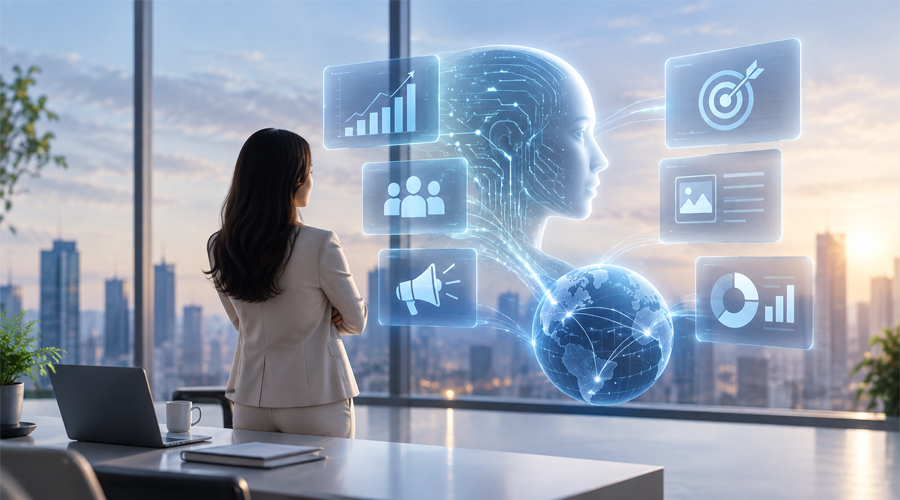
Enterprise marketing has become harder to manage as brands expand across search, social media, websites, apps, email, paid advertising, and customer support. Each channel produces customer data, while customers expect faster responses and more relevant communication.
For large organisations, disconnected platforms and manual processes can slow down decision-making. Artificial intelligence is changing this model by helping marketing teams analyse data, automate routine work, personalise communication, and improve campaign performance.
The shift towards AI-first marketing is not about replacing people. It is about helping teams make better decisions, respond faster, and manage complex customer journeys with greater control.
Why Enterprise Marketing Is Moving Towards AI?
Traditional marketing automation is based on set rules. When a customer performs an action, a pre-set message is sent. This approach will work for simple tasks, but it will not always be able to cope with changing customer behavior.
AI can be used to process extensive amounts of information and uncover patterns that teams might not detect. This can aid in forecasting customer requirements, comprehending buying intent, and suggesting the next action.
It's helpful for enterprise brands as they have a lot of data from different sources, such as websites, apps, CRM, advertising platforms, sales teams, and purchase history. AI can link these signals to get a better understanding of the customer.
This helps marketing teams move from reactive communication to more timely and relevant engagement.
How Is AI Changing the Way Marketing Teams Work?
AI can be used in various aspects of marketing.
Generative AI can assist with generating email drafts, ad copy, product descriptions, images and video concepts. These tools can help teams create additional content variations without adding to manual efforts.
Predictive AI examines customer history to forecast their next actions. It can signal individuals who would likely be looking to buy, disengage, unsubscribe, or require assistance.
AI-driven automation acts on these signals to take appropriate actions. For instance, if a customer has been to a product page multiple times, they can be served relevant information, and if a customer is inactive, they can be part of a re-engagement journey.
This way, enterprise teams can oversee more complicated campaigns and devote more time to strategy, creativity, and customer relationships.
Better Customer Insights at Enterprise Scale
Enterprise brands gather data from their customers at multiple touchpoints. It's not that there's a lack of data. It's the challenge of making that data useful in making decisions.
AI can analyse customer browsing, purchasing history, engagement in campaigns, customer feedback, and sales interactions. The insights work to identify high value customers, probable buyers, and those who are beginning to show signs of disengagement.
AI can also enhance audience segmentation. Marketers don't just need to categorise customers by age, location, or interests but can look at product interest, engagement, previous actions, and buying intent.
AI can be more helpful when taking multiple signals into account when scoring a lead. A prospect that visits important product pages or downloads resources and responds to sales communication can be given more attention than to a prospect who has merely opened an email.
This information can be used to help inform AI Seo Services and guide teams in understanding the topics audiences are interested in, the questions they ask, and the kind of content they are looking for.
The Benefits of AI-Powered Personalisation
1. More relevant communication: AI adjusts messages based on customer interests, preferences, and behaviour.
2. Better product recommendations: E-commerce brands can suggest products based on browsing and purchase history.
3. Improved customer journeys: Customers can receive different messages depending on whether they are researching, purchasing, or returning for another order.
4. Timely follow-ups: AI can trigger abandoned-cart reminders, product updates, and re-engagement messages at suitable times.
5. Personalisation across channels: Brands can deliver relevant content through email, SMS, websites, apps, and paid media.
6. Less manual work: AI performance marketing helps marketing teams personalise communication for large audiences without managing every interaction individually.
7. Stronger customer engagement: Relevant messages are more likely to capture attention and encourage customers to take action.
8. Responsible data use: Brands must protect customer data, follow consent requirements, and review automated decisions to maintain trust.
Where Can Enterprise Brands Apply AI?
AI has practical uses across several areas of enterprise marketing.
1. Content and creative production: Generative AI can support first drafts of social posts, emails, product descriptions, ad copy, images, and video concepts. Human teams remain responsible for originality, brand voice, accuracy, and final approval.
2. Customer support: Chatbots and virtual assistants can answer routine questions, provide product information, and guide customers to the right resource. Complex complaints and sensitive conversations should continue to involve human teams.
3. E-commerce marketing: AI can support product recommendations, abandoned-cart recovery, personalised offers, and customer profile updates. These functions help brands maintain relevant communication before and after a purchase.
4. Lead scoring and retention: Predictive systems can identify prospects who are more likely to convert and customers who may stop engaging. Teams can then prioritise follow-ups and retention activity.
Conclusion
AI is transforming the marketing landscape for big companies. It can assist teams to learn about customers, minimise manual duties, customise messages, and enhance campaigns.
However, AI requires human operators. Businesses require solid information, strong aims, proper data protection, and human oversight to ensure that the technology is being utilised correctly.
For the best digital marketing agency in India, like Hawk Martech, this means bringing marketing, creative, technology, AI, and automation together instead of treating them as separate services.
Want to use AI to improve your marketing? Contact us today.
FAQs
Q1. How is AI changing enterprise marketing?
A. AI helps enterprise marketing teams analyse customer data, identify behavioural patterns, personalise communication, automate repetitive tasks, and optimise campaigns.
Q2. Can AI replace enterprise marketing teams?
A. No. AI can automate repetitive work and support decision-making, but marketers remain responsible for strategy, creative direction, brand voice, accuracy, customer experience, and final decisions.
Q3. What should enterprises consider before adopting AI in marketing?
A. Enterprises should assess data quality, technology integration, privacy and consent requirements, business objectives, human oversight, and how AI will fit into existing marketing processes.
